Lean Six Sigma Black Belt Program
LSS Black Belt Course Outline and Information
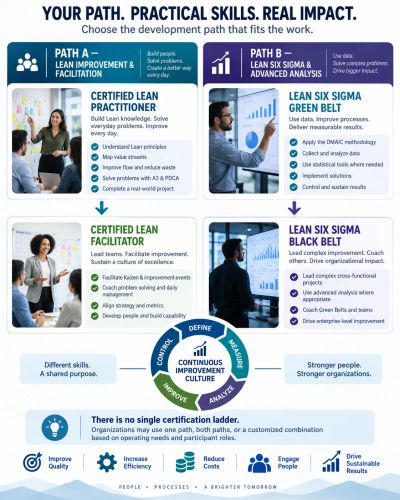
The Lean Six Sigma Black Belt program equips experienced practitioners with the advanced methods, leadership techniques, and strategic mindset needed to drive enterprise-wide improvement. At your own pace with 12 months of access, you’ll master multivariate statistical analysis, design and optimize experiments, manage complex change initiatives, and coach Green Belts and project teams to sustainable results. Through real-world case studies, course exercises, and a capstone project, you’ll emerge ready to lead high-impact process transformations, align improvement initiatives with business strategy, and build a culture of continuous improvement across your organization. The program is accredited by the Council for Six Sigma Certification.
Learning Objectives
- Lead and mentor cross-functional improvement teams, serving as a coach for Green Belts and project stakeholders.
- Apply advanced statistical techniques—ANOVA, regression, multivariate analysis, and time-series forecasting—to uncover root causes and predict outcomes.
- Plan, design, and analyze experiments using DOE methods (full factorial, fractional, and response surface) to optimize key process variables.
- Develop and validate robust Measurement Systems Analysis (MSA) and process capability studies to ensure data integrity and process stability.
- Conduct comprehensive risk assessments and FMEAs, integrating results into project charters and control plans.
- Use strategic deployment tools (Hoshin Kanri, QFD, etc.) to align improvement projects with organizational objectives.
- Integrate Lean methods—value stream mapping, SMED, TPM, Kanban—into Six Sigma projects for flow optimization and waste elimination.
- Implement advanced simulation and modeling techniques (Monte Carlo, ARIMA) to evaluate process scenarios and support decision-making.
- Design and sustain control systems—SPC, visual dashboards, Leader Standard Work—to lock in gains and track performance over time.
- Lead change management efforts, employing coaching mindsets (GROW, Kata), stakeholder engagement strategies, and communication plans.
- Synthesize project learnings into executive-level presentations, demonstrating measurable financial and operational impact.

Lean Six Sigma Black Belt Program Curriculum
Certified LSS Black Belt
The Certified Lean Six Sigma Black Belt course includes all Green Belt modules and adds advanced Lean Six Sigma methods, leadership, strategy deployment, statistical analysis, design of experiments, coaching, facilitation, and Lean transformation topics. This program is designed for professionals who lead complex improvement projects, coach Green Belts, support organizational alignment, and help build sustainable continuous improvement capability.
Green Belt Foundation Modules Included:
1. Introduction to Lean Six Sigma
Introduces Lean Six Sigma principles, the relationship between Lean and Six Sigma, the Seven Wastes, implementation considerations, basic templates, and project selection.
2. Project Management and Project Chartering
Covers project management fundamentals for Lean Six Sigma projects, including project charter development, project scope, objectives, team roles, and execution planning.
3. Value Stream Mapping
Teaches current state and future state value stream mapping for manufacturing, administrative, and healthcare processes, including practical case assignments.
4. Team Facilitation and Define Phase
Develops basic team facilitation skills, brainstorming techniques, problem definition, process definition, and the use of project charter tools to launch improvement work effectively.
5. Voice of the Customer and Measure Phase
Covers customer requirements, measure phase planning, sampling plans, data collection, basic measurement tools, descriptive statistics, process capability, and measurement systems analysis.
6. Analyze Phase
Introduces graphical analysis, multi-vari studies, failure mode and effects analysis, hypothesis testing concepts, inferential statistics, and an overview of design of experiments.
7. Improve Phase: Lean Tools and Solution Development
Focuses on solution selection, benchmarking, digital transformation opportunities, standardized work, leveling work, 5S, TPM, OEE, autonomous maintenance, and quick changeover.
8. Improve Phase: Flow, Pull, and Kaizen
Covers mistake proofing, continuous flow, cell layout, material delivery to cells, kanban systems, inventory management, trigger point calculations, supplier pull systems, and kaizen event planning and execution.
9. Control Phase
Teaches control plans, visual management, Lean metrics, control charts, and methods for sustaining process improvements after solutions have been implemented.
Advanced Black Belt Modules
10. Leadership, Strategy, and Organizational Alignment
Covers strategy deployment, Lean metrics, leading in a Lean culture, daily management, leader standard work, change management, Lean extended enterprise concepts, and extending Lean to suppliers and partners.
11. Advanced Hypothesis Testing
Develops deeper statistical problem-solving capability through hypothesis testing for normal data, non-normal data, discrete data, regression, and correlation.
12. Advanced Design of Experiments and Simulation
Covers fractional factorial designs, response surface methods, time series analysis, ARIMA using SigmaXL, Monte Carlo analysis, and Monte Carlo analysis for design optimization.
13. Skills Development and Training Within Industry
Introduces Training Within Industry methods, including Job Methods, Job Instruction, Job Relations, skills development, and cross-training systems.
14. Advanced Facilitation and Lean Coaching
Develops advanced team facilitation, ground rules, Improvement Kata, Coaching Kata, Lean coaching frameworks, coaching mindsets and behaviors, visual coaching tools, systems thinking, and coaching for sustainability.
15. Design for Six Sigma and Lean Product Development
Covers the DMADV approach to design, Quality Function Deployment, Lean product development, knowledge wastes in development, set-based concurrent engineering, trade-off curves, design for manufacturability, and 3P events.
Final Black Belt Assignment and Test
Participants complete final Black Belt assignments and testing to demonstrate advanced Lean Six Sigma knowledge, project leadership capability, analytical problem solving, facilitation skill, and readiness to support broader organizational improvement.The Certified Lean Six Sigma Green Belt course provides a practical foundation in Lean Six Sigma methods, DMAIC project execution, process improvement, data collection, root cause analysis, and sustainment. Participants learn how to define improvement opportunities, measure process performance, analyze causes, implement solutions, and control improved processes through a structured project-based approach.