Lean Six Sigma Green Belt Certification Online
LSS Green Belt Course Outline and Information
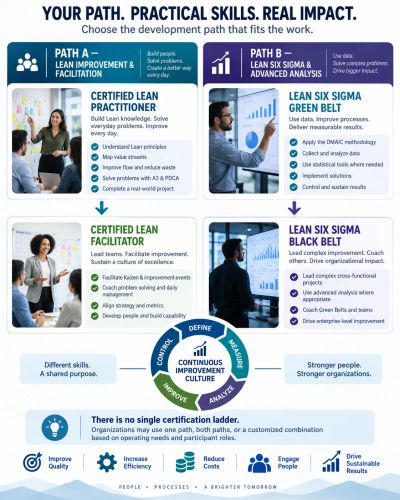
The Lean Six Sigma Green Belt program empowers professionals to identify waste, solve root causes, and drive measurable improvements in their workplace. Designed for hands-on learners and team contributors, this course blends Lean thinking with Six Sigma rigor—giving you the tools to map processes, analyze data, and implement solutions that last. You’ll learn how to lead localized improvement projects, engage cross-functional teams, and apply DMAIC methodology to deliver meaningful results. Whether you’re in manufacturing, healthcare, finance, or service operations, the Green Belt credential positions you to make immediate impact. The program is accredited by the Council for Six Sigma Certification.
Note: This program uses SigmaXL statistical software and will include a license for 1 person.
Learning Objectives
- Explain the principles of Lean, Six Sigma, and the DMAIC framework.
- Facilitate project selection and charter creation aligned to strategic goals.
- Map processes using SIPOC, value stream mapping, and swimlane diagrams.
- Identify root causes using data collection plans, fishbone diagrams, Pareto charts, and the 5 Whys.
- Assess process performance using descriptive statistics, histograms, and process capability metrics.
- Evaluate data reliability through Gage R&R and basic Measurement Systems Analysis.
- Conduct graphical and exploratory analysis to spot variation and stability signals.
- Recognize appropriate applications of control charts, run charts, scatter plots, and multi-vari studies.
- Apply the PDCA cycle and pilot testing to implement change and measure effectiveness.
- Develop control plans and visual management systems to sustain improvements.
- Lead basic Kaizen events, facilitate team collaboration, and coach problem-solving approaches.
- Collaborate with stakeholders across departments to align improvement efforts and communicate outcomes.

Lean Six Sigma Green Belt Program Curriculum
Certified LSS Green Belt
The Certified Lean Six Sigma Green Belt course provides a practical foundation in Lean Six Sigma methods, DMAIC project execution, process improvement, data collection, root cause analysis, and sustainment. Participants learn how to define improvement opportunities, measure process performance, analyze causes, implement solutions, and control improved processes through a structured project-based approach.
1. Introduction to Lean Six Sigma
Introduces Lean Six Sigma principles, the relationship between Lean and Six Sigma, the Seven Wastes, implementation considerations, basic templates, and project selection.
2. Project Management and Project Chartering
Covers project management fundamentals for Lean Six Sigma projects, including project charter development, project scope, objectives, team roles, and execution planning.
3. Value Stream Mapping
Teaches current state and future state value stream mapping for manufacturing, administrative, and healthcare processes, including practical case assignments.
4. Team Facilitation and Define Phase
Develops basic team facilitation skills, brainstorming techniques, problem definition, process definition, and the use of project charter tools to launch improvement work effectively.
5. Voice of the Customer and Measure Phase
Covers customer requirements, measure phase planning, sampling plans, data collection, basic measurement tools, descriptive statistics, process capability, and measurement systems analysis.
6. Analyze Phase
Introduces graphical analysis, multi-vari studies, failure mode and effects analysis, hypothesis testing concepts, inferential statistics, and an overview of design of experiments.
7. Improve Phase: Lean Tools and Solution Development
Focuses on solution selection, benchmarking, digital transformation opportunities, standardized work, leveling work, 5S, TPM, OEE, autonomous maintenance, and quick changeover.
8. Improve Phase: Flow, Pull, and Kaizen
Covers mistake proofing, continuous flow, cell layout, material delivery to cells, kanban systems, inventory management, trigger point calculations, supplier pull systems, and kaizen event planning and execution.
9. Control Phase
Teaches control plans, visual management, Lean metrics, control charts, and methods for sustaining process improvements after solutions have been implemented.
Applied Green Belt Project
Participants complete a Lean Six Sigma Green Belt project demonstrating their ability to apply DMAIC methods to a real-world improvement opportunity. The project reinforces practical use of Lean Six Sigma tools, data-based problem solving, improvement implementation, and process control.